History
Foundation of IST - Alfredo Bensaúde appointed Director
Museum hall plate of the IST Main Library
The Instituto Superior Técnico (IST) was created in 1911 from the division of the Industrial and Commercial Institute of Lisbon. Alfredo Bensaúde, an Engineer, was the first Director of IST (1911-1922) and promoter of a wide-rang reform in the Portuguese higher technical education, responsible for the first Engineering courses at IST: Mining, Civil, Mechanical, Electrical, and Chemical-Industrial. The second Director of IST was Duarte Pacheco (1927-1932), also an Engineer, who was responsible for the construction of the university campus at Alameda. Meanwhile IST became part of the recently created Technical University of Lisbon. Throughout the following decade, the image of engineers from IST was projected into major engineering works, promoted by Duarte Pacheco, who was by the time Minister of Public Works.
Creation of the first Study and Research Centres
Between 1952 and 1972, 12 study centres were established in Portugal, three of them at IST, in the fields of Chemistry, Geology and Mineralogy, and Electronics. These centres were responsible for promoting faculty staff training and scientific qualification through doctoral studies in universities and research centres abroad. In 1970, the minimum period for obtaining a Bachelor degree decreased from six to five years, and IST denotes a remarkable increasing of the number of students. During this period, scientific research at IST showed a major increase, through the creation of the Complexo Interdisciplinar which fasten together various autonomous research units, and contributes to transform IST in a reference school at European level.
Alameda Campus (1936-1937). Photographer: Mário Novais. The Art Library of the Calouste Gulbenkian Foundation
Beginning of IST activities at Taguspark campus
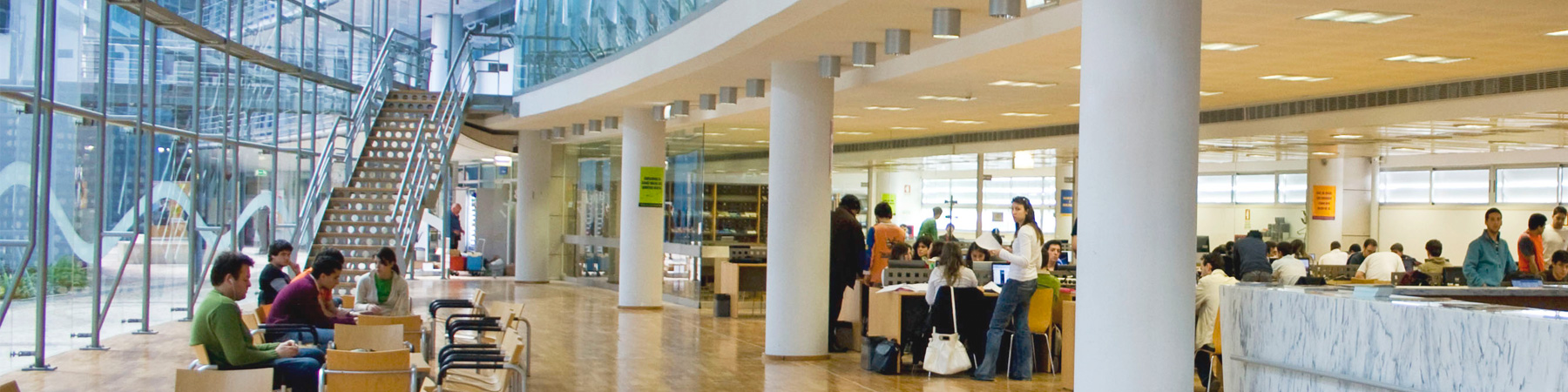
Taguspark Campus Hall
In the 1990s, new courses were created in cutting-edge engineering areas, including Master and Doctoral programmes. In 2001, IST inaugurated a new campus in Oeiras, located in a Science and Technology Park, the TagusPark, which involves more than 120 technology-based companies. Recently, in the academic year of 2006-2007, the Declaration of Bolonha was successfully implemented in all IST courses, aiming the establishment of a European Education Space to make Europe the most competitive knowledge-based economy in the world by 2010.
IST - A National and International reference
Today’s IST is recognised as a Great School of Engineering, Architecture, Science & Technology, in Portugal and worldwide. IST is involved in some of the most prestigious RD&I and technology transfer institutions in Portugal, with remarkable impact internationally at many scientific and technological domains. A vast number of courses in cutting-edge engineering areas, at undergraduate, Master and Doctoral levels, are nowadays offer at IST. IST is also actively involved in several networks and international programmes to promote student mobility, both at undergraduate and postgraduate levels. Through a large number of agreements with other institutions worldwide, IST participates in more than 20 Dual Master programmes, and joint PhD programmes with MIT, CMU, UT-Austin e EPFL.
The “Chico” Robot. The outcome of an international project with IST participation.